

How To Draw Blood From A Hard Stick Patient
What if y'all can't find veins on a patient, however you demand to start an Iv, describe blood, or perform other venipuncture procedures? This happens more than often than you'd think, and even seasoned nurses struggle to find veins in patients who are obese, dehydrated, or suffering from advanced renal or heart illness.
Luckily, there are some things you tin can do to increases your chances of sticking i of those hard-to-find veins.
*Disclaimer: Earlier yous kickoff, e'er remember to follow the latest protocols and best practices for your area.
How to Find Veins in Patients
First, it'due south of import to continue in mind that your patient volition likely take a vein to stick. I've had many patients tell me that they are incommunicable to stick, yet I've been able to successfully striking their vein. Nevertheless, there will be times when you lot can't easily observe a vein, and you must resort to other tactics.
Tip #ane: Use Palpation to Discover Difficult Veins, not Sight
When you have healthy patients, those veins are popping out and very easy to encounter. Notwithstanding, when your patient isn't so healthy, you lot'll take to rely on palpation to find those hard veins.
This is where it becomes very important to have those vein locations memorized. While there can be variations in the anatomy of your patients, the vein locations should be consistent.
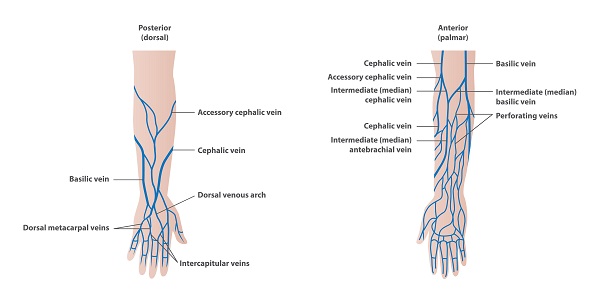
Next, you'll accept to learn through experience what a vein actually feels like as you palpate the arm. I learned this by practicing on myself. I'd apply a tourniquet to my arm and then feel around the front and back.
Veins accept a very unique feel to them. They are squishy yet boisterous. I tin can nevertheless remember trying to palpate when I was a new nurse, and I'd ask my preceptor, "Is this a vein?" She'd respond, "No, that's merely a ligament (or tendon)."
By practicing on yourself (and other healthy people with good veins), y'all'll become familiar with the feel of a vein. This will enable you to starting time IVs by palpation, rather than past sight.
Tip #2: Use Gravity and a Tourniquet
If you still tin can't find veins past palpation, you lot tin always utilize gravity and a tourniquet to assistance the veins become engorged and visible. Veins are very much similar your typical water hose: if y'all kink the hose, what happens? Pressure builds up, and the hose expands.
Veins operate in a like way. If you apply a tourniquet and have the patient hold their arm down and tighten or pump their fist, the veins will become engorged and more visible, which volition increase your chances of finding a vein to stick.
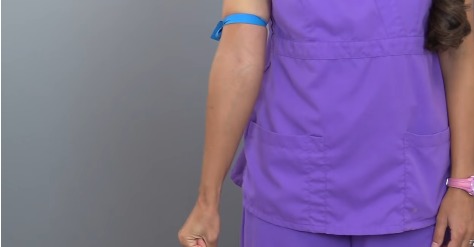
However, proceed in mind that this technique can't always be used, especially in cases where the patient is having claret drawn for sensitive lab piece of work, as fist pumping can change blood levels of potassium and other things. However, you lot'd be surprised at how effective this can be in finding veins.
Tip #three: Use Vein Finders or Vein Lights
In my experience, the starting time two methods mentioned to a higher place (palpation and tourniquet / gravity) will assist you observe veins in the bulk of your patients. Still, sometimes yous have to take it a footstep further and use another method.
Vein finders often use infrared light to detect veins in the arm, while vein lights help to illuminate the skin to reveal hidden veins. These can exist helpful in situations where you can't use the tourniquet and paw pumping technique.
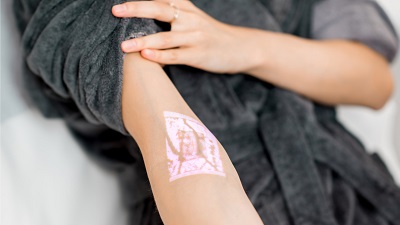
Tip #4: Apply Ultrasound to Discover Veins
If you lot don't have a vein finder or vein light, ultrasound techniques can likewise exist used to discover veins. Ane time I had a patient who thought that they'd take to have a key line before the stress test, because they felt that I'd be unable to find a expert vein to stick.
Central lines can be very expensive and lead to an increased risk of infection. Therefore, I consulted with ultrasound, and I was able to observe a vein to stick, which saved the patient from the cost and risk of having a central line placed for the procedure.

Yet, if you do have a patient who volition exist admitted for extra procedures, a central line might make sense. You can always consult with the medico to meet if the patient is a practiced candidate for a cardinal line.
And finally, some nurses use hot compresses to aid the veins become engorged. I have never used this method myself, but some nurses prefer this method.

Source: https://www.registerednursern.com/hard-find-veins/
Posted by: larsonpaorat.blogspot.com
0 Response to "How To Draw Blood From A Hard Stick Patient"
Post a Comment